How AI for Restaurants is Transforming the Dining Industry in 2026

The restaurant industry is undergoing a rapid transformation in 2026, with the evolution of AI for restaurants. When you think about AI, the first thing that comes to your mind is a computer brain. Earlier, manual errors in restaurants impacted customer expectations and satisfaction.
Now, AI and machine learning technologies are very fast and efficient, so some restaurants are adopting them for daily operations.
69% of restaurants are adopting AI, but only 6% use it where it matters most: customer orders.
In the food service industry, businesses are looking for AI for restaurants to reshape their operations in the competitive market. There are some claims that AI will replace restaurant employees, which looks impractical.
Let’s explore how AI for restaurants is transforming the dining industry and why adoption is important for modern food service.
AI for Restaurants
AI for restaurants, as the name indicates, is artificial intelligence technology that helps restaurants manage and automate operations, kitchen workflows, and improve decision-making. It empowers restaurant staff to make better decisions, provide fast & personalized service, and enhance the dining experience.
Let’s explore some important terms:
Artificial Intelligence (AI)
Essentially, artificial intelligence functions as a synthetic human intellect. It is a field of technology dedicated to engineering systems and machinery capable of undertaking responsibilities typically associated with human intelligence.
These systems acquire the ability to mirror human behavior by executing operations such as identifying patterns, learning from data, and making autonomous decisions.
Using advanced models and algorithms, these computer systems continuously refine their performance across various tasks. They can simulate intelligent human behavior, as seen in virtual assistants like Siri and Alexa, as well as in generative AI platforms such as Google Gemini and ChatGPT.
Machine Learning (ML)
What is machine learning? It comes to mind when you think about artificial intelligence. Machine learning is a subpart of AI that helps design computer systems that can learn from shared data and perform tasks as humans do. ML uses many complex algorithms for tasks such as data learning, decision-making, and pattern recognition, etc. It is used in various applications such as data analysis and fraud detection.
Role of AI in Transforming Modern Restaurants
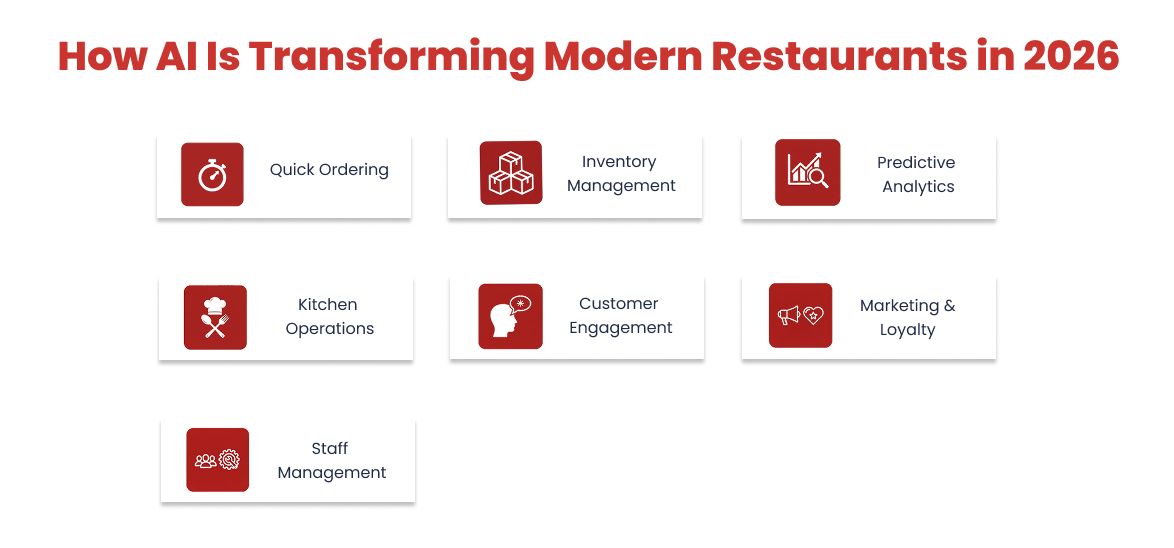
1. Quick Ordering and Personalized Experiences
Artificial intelligence plays a crucial role in the restaurant industry; its implementation on apps has already begun. In restaurants, you can see AI in ordering systems, which include mobile apps, chatbots, and kiosks, and in POS systems.
AI-driven personalization can lift average order value from 12% to 18% while kiosks reduce waiting time by 25% and order errors by 19%.
Key Benefits
- Implementing AI for restaurants to provide personalized recommendations to their customers by analyzing purchase history, previous orders, best-selling items, and more.
- It also helps restaurants reduce customers’ wait times by automating order processing.
- Upsell opportunities will increase with the implementation of AI in restaurants, as it can recommend combos, offers, add-ons, and more.
2. Inventory Management
Restaurant Inventory management is the most essential part of the food market in the USA. Inefficient restaurant inventory management results in stockouts, overstocking, and loss of sales. Restaurants using AI inventory finds 25% less food waste and 90% fewer stockouts.
It Assists:
- It can automate stock management, preventing stockouts and overstocking.
- AI can help restaurants track stock usage in real time.
- It can help reduce food waste caused by overstocking.
- It can easily predict product demand based on past usage data, local events, and more.
3. Predictive Analytics
The data has become a crucial asset for restaurants and other businesses. Implementing AI in restaurants helps businesses use predictive analytics to make data-driven decisions, benefiting their restaurant growth.
Applications
- AI helps plan the employee schedule effectively.
- It forecasts daily and seasonal customer demands.
- It optimizes pricing strategies and selling meals.
- AI can identify the best-selling and non-performing items easily.
4. Kitchen Operations
AI in restaurants manages front-of-house operations and kitchen operations. 48% of restaurants now use AI-powered tools, from online ordering optimization and kitchen display systems to AI phone answering and predictive inventory.
Key Innovations
- AI allows restaurants to track food waste and optimize kitchen operations.
- It provides automated kitchen solutions that reduce manual errors and speed up meal preparation.
- It can easily be integrated with KDS to manage customer orders.
5. Enhanced Customer Engagement
Good customer service is what makes restaurants successful. AI-powered chatbots are being introduced to the restaurant industry to serve customers. These chatbots handle customer communications across various platforms such as mobile apps, websites, social media, etc. Chatbots can provide quick answers, and guidance can work 24/7 to provide great customer experiences.
Conversational AI chatbots would autonomously resolve 80% of common customer service issues without human intervention by 2029. This advancement is expected to lead to a 30% reduction in businesses’ operational costs.
What AI chatbots do:
- 24/7 customer support
- Answer the FAQ quickly
- Give real-time updates
- Handle table reservations
- Recommend menu items.
6. Marketing and Loyalty Programs
Marketing in restaurants is data-driven nowadays. AI in restaurants studies customer behavior, buying habits, and preferences to create detailed marketing campaigns. This will lead to higher customer retention and greater sales. As per the research, AI-personalized emails achieve 41% higher click-through rates than generic campaigns.
Key Features
- Automated loyalty and rewards program.
- Personalized marketing campaigns
- Predictive promotions as per customer behavior.
- Automated follow-ups.
7. Staff Management
Labor costs and staff shortages in the restaurant industry pose major challenges. The implementation of AI-powered POS systems manages the workforce and automates staff scheduling, enhances productivity, and more. It creates the staff schedules by analyzing the sales trends and customer demand.
Benefits:
- Reduces overstaffing problems.
- Track staff performance and productivity.
- Automates payroll and attendance tracking.
- Reduces scheduling errors.
Conclusion
AI’s impact on restaurants in 2026 boosts operational efficiency and customer experiences. Artificial Intelligence is changing the restaurant industry, helping restaurant owners make data-driven decisions and provide quality service in the competitive market. With the evolving technology, AI will become a necessity in modern-day restaurant POS systems.