Payment Processing for Restaurants – Everything You Need to Know

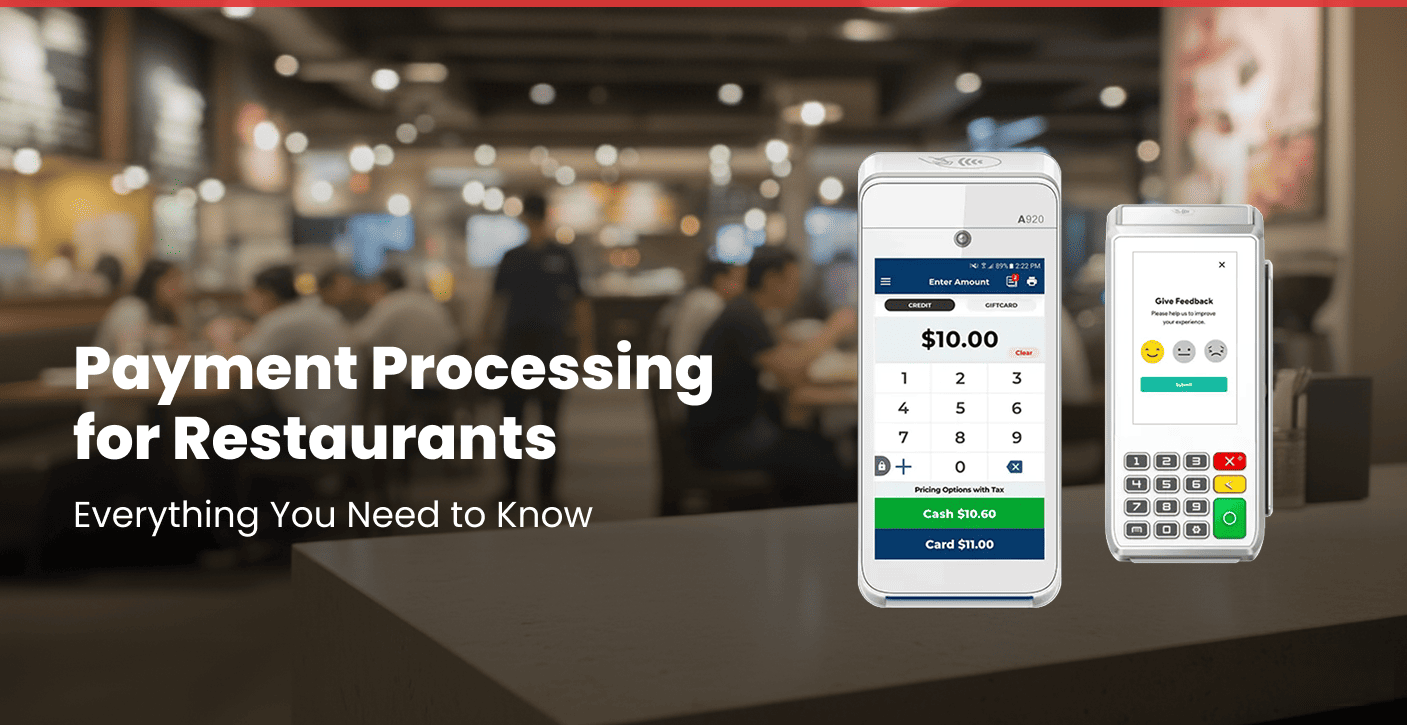
Table of Content
- What is Restaurant Payment Processing?
- What makes Restaurant Payment Processing crucial for modern businesses
- How to Choose the Right Payment Processor for Your Restaurant
- Top 5 Restaurant Payment Processing Solutions in 2026
- Restaurant Payment System: Top Features to Look at
- Important Benefits of a Restaurant Payment System
- Key Takeaways
- Frequently Asked Questions
US restaurants are fast-paced and growing rapidly globally. It is essential to ensure that payment processing is done correctly, whether in full-service dining, quick-service restaurants, or food trucks. The restaurant industry is projected to reach $1.5 trillion in sales this year.
If you plan to run a restaurant or outlets in the USA, then this blog will help you understand how payment processing works for restaurants. It will help you to set up and optimize the guest experiences and costs.
In this blog, you will learn about payment processing basics, best practices, and evaluate options like Quantic POS.
What is Restaurant Payment Processing?
Restaurant Payment processing is how a restaurant or any business accepts payments from customers using debit cards, credit cards, or mobile pay, etc.
The payment processing mainly includes:
- Merchant account: A merchant account that works with a processor or the bank.
- Payment gateway: A payment gateway used for mobile and online payments works with card networks.
- POS Terminal: A POS terminal helps to capture payments using cards, NFC, and mobile wallets.
- Authorization: The card owner will verify the funds and determine whether they are legitimate.
- Settlement: The batched transactions and debited funds will be deposited into the restaurant or other business account.
What makes Restaurant Payment Processing crucial for modern businesses
According to the National Restaurant Association, restaurants reported total sales of $99.5 billion in August 2025.
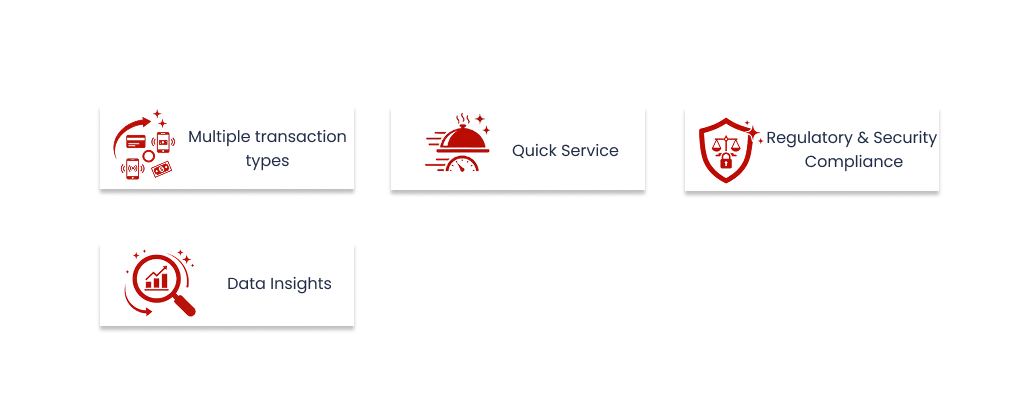
Multiple transaction types
Restaurant Payment processing is more complex than standard retail because it supports features like split bills and more.
- Pre-authorized cards let you keep tabs open for casual dining, and you can pay the final amount later.
- Customers use Quantic’s split-check feature to pay bills across multiple cards.
- In table-side payments, restaurants take payments at the table.
Quick Service
The payment processing allows fast checkouts, minimizing the long queues during peak hours.
- Fast payments allow restaurants to provide quick services with seamless operations.
- The QSR mainly relies on the service speed and accurate billing.
- Contactless and tableside payments enhance the customer dining experience using fast payment processing.
Regulatory and Security Compliance
Restaurant payment processing must be PCI compliant to handle customer payment information securely.
- Secure processes, such as data encryption and controlled access, help ensure compliance and build customer trust.
- It supports EMV and contactless payments, enhancing payment security.
- It also protects sensitive customer information on each transaction.
Data insights
Data-driven insights allow restaurants to make profitable decisions. For each customer payment, crucial information is tracked in reporting and analytics tools, including purchase trends and customer behavior.
- Real-time performance has been monitored across multiple locations.
- It helps to identify the best-selling and least-selling items.
- It tracks sales trends by category, hour, or day.
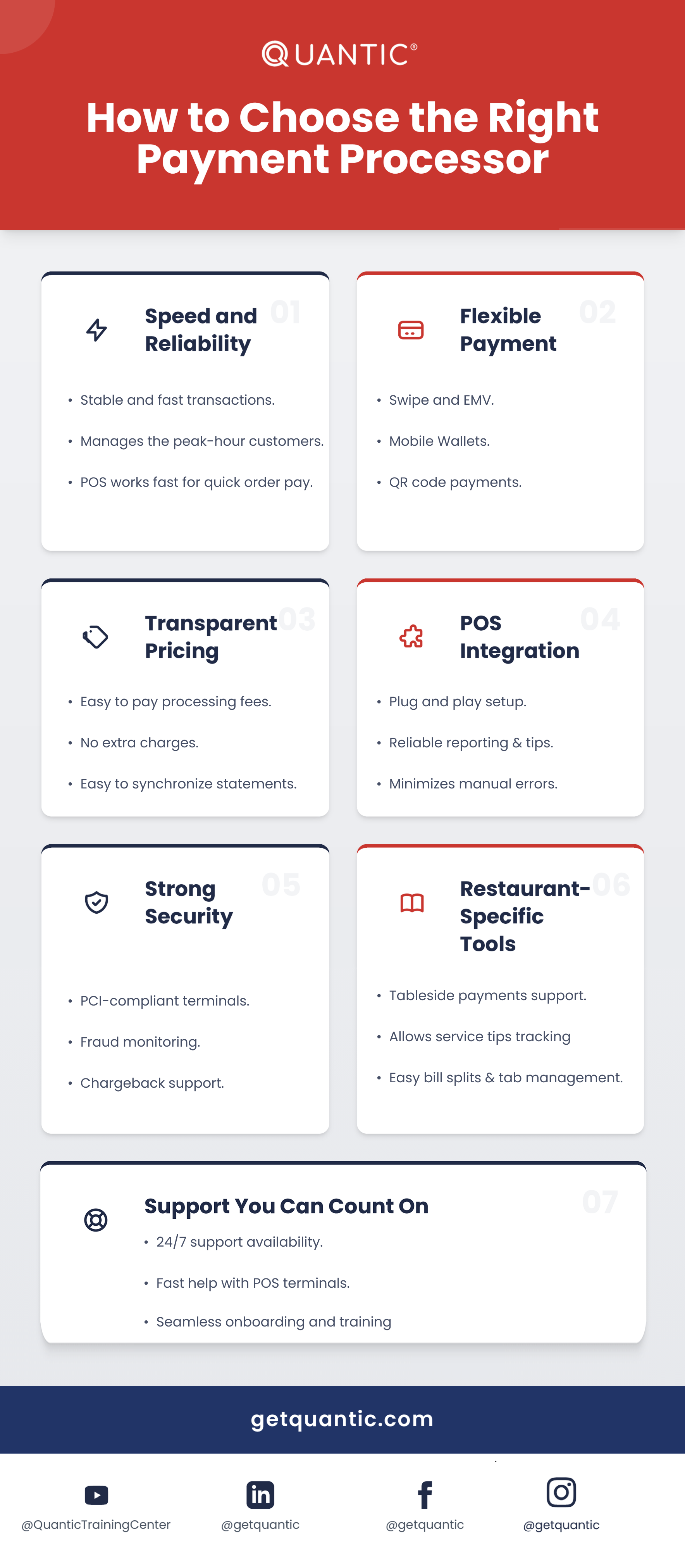
How to Choose the Right Payment Processor for Your Restaurant
Top 5 Restaurant Payment Processing Solutions in 2026
| Solutions | Payment Partners / Processors | Best For | Key Advantage |
|---|---|---|---|
| Quantic POS | Payroc, Fiserv, Elavon, TSYS | Restaurants seeking POS + integrated payments | Processor-agnostic platform with restaurant-specific payment tools |
| Fiserv | Fiserv | Small to large restaurants | Established payment processing and Clover ecosystem |
| Global Payments | Global Payments | Multi-location restaurants | Scalable payment and commerce solutions |
| Worldpay | Worldpay | Growing and enterprise restaurants | Omnichannel payment infrastructure |
| Shift4 | Shift4 | Restaurants and hospitality businesses | Integrated payments and hospitality technology |
Restaurant Payment System: Top Features to Look at
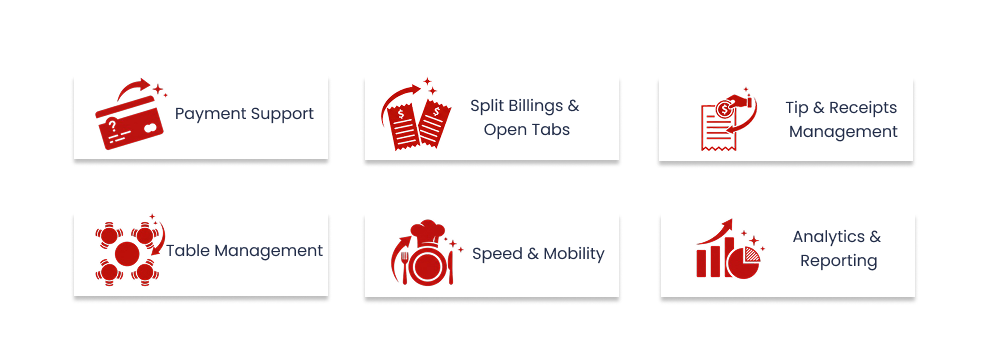
| Feature | What to Look For | Restaurant Benefit |
|---|---|---|
| Payment Support | Cards, NFC, mobile wallets | Flexible checkout |
| Split Billing & Open Tabs | Split by seat, item, or guest | Faster billing |
| Tip & Receipt Management | Tip adjustment and digital receipts | Easier payment management |
| Table Management | Floor plans and table status | Better table utilization |
| Speed & Mobility | Handheld POS and Tap to Pay | Faster service |
| Analytics & Reporting | Real-time sales and payment data | Better decision-making |
Restaurant payment processing is a crucial component of the POS system, encompassing various concepts related to accepting payments. Payment processors work faster by offering accuracy and better customer experiences. It also integrates easily with front- and back-of-house operations.
Here are some important payment system features for modern restaurants in detail.
1. Payment Support
Many customers want fast and flexible payment options at checkout. Limited payment options can negatively impact businesses and their customers’ satisfaction. So, multiple payment methods should always be available in payment processors.
Check for:
- Look for swipe, contactless, and chip transactions.
- Need mobile wallets like Apple Pay, Google Pay, Amazon Pay, and more to be highly compatible.
- Should offer seamless integration for in-person and online payment.
What we offer
Quantic offers NFC, swipe, and digital payments like Apple Pay, Google Pay, and more. It gives the freedom to pay anywhere.
2. Split Billings & Open Tabs
In full-service restaurants, when guests split checks or have open tabs, manual handling can negatively affect the customer experience. Manual handling can result in slow service and billing errors.
Check for:
- Look for the various options to split checks by seat, item, or guest.
- Should be capable of easily merging, transferring, and reopening the tabs.
- For payment security, it should include pre-authorization for tabs.
What we offer
Quantic POS manages the bill splits, allowing servers to divide checks by guest, item, and seat. It will reduce the billing errors during peak hours.
3. Tip & Receipts Management
For seamless restaurant operations, effective tip and receipt management is important. POS can simplify your tips, processing, and reports.
Check for:
- Should be able to add or adjust tips in the table service.
- Can easily automate tip reports for payroll and compliance.
What we offer
Quantic POS supports tips and receipt management features that help manage accuracy and compliance for all payment types.
4. Table Management
Effective floor management maximizes seat capacity, order accuracy, and improves server coordination. A reliable POS helps visualize and manage the dining room in real time.
Check for:
- Should have clear visibility to the floor plans, along with table sections and server assignments.
- Can easily check that tables are open, billed, closed, or seated by instant view.
- Can easily track dining progress to maintain seamless restaurant operations.
What we offer
Quantic POS provides effective floor mapping, including the table layouts and server assignments. Restaurant owners can check table visibility and streamline seating operations during peak hours.
5. Speed & Mobility
In quick-service restaurants, fast payment options improve table turnover, reduce customer wait time, and enhance the customer experience. A powerful POS helps restaurants and customers make transactions easily, anywhere.
Check for:
- Look for the Handheld POS Devices for table-side ordering and payments to get quick service.
- Check self-ordering kiosks and QR ordering for quick service, which helps customers to order and pay.
- Look for contactless checkout via tap-to-pay options for smooth operations.
What we offer
Quantic POS supports table-side ordering, enabling servers to take orders and accept payment on-site. Handheld devices, Kiosks, and QR code payments help minimize wait times and enable quick service, resulting in a better customer dining experience.
6. Analytics & Reporting
Reporting and analytics are a core feature of a restaurant payment system. It plays a crucial role for restaurants, helping them develop strategies for menus, their staffing, and overall kitchen operations.
As per the research, 71% of restaurant owners use point-of-sale (POS) data to increase customer engagement, optimize their menu, and streamline payments.
A smart POS should have all these aspects to enhance the restaurant’s performance. It also provides real-time insights into sales performance, best-selling items, etc.
Check for:
- Check the real-time dashboard to track sales, customer payments, and tips.
- Look for detailed reporting that helps you understand dine-in, delivery, takeout, and payment types.
- Also, check for seamless operations, manage chargebacks, history, and staff performance.
What we offer
Quantic POS doesn’t just process payments; it also interprets data in real-time analytics and reporting, which allows you to make the right decisions that increase profit margins and sales.
Important Benefits of a Restaurant Payment System
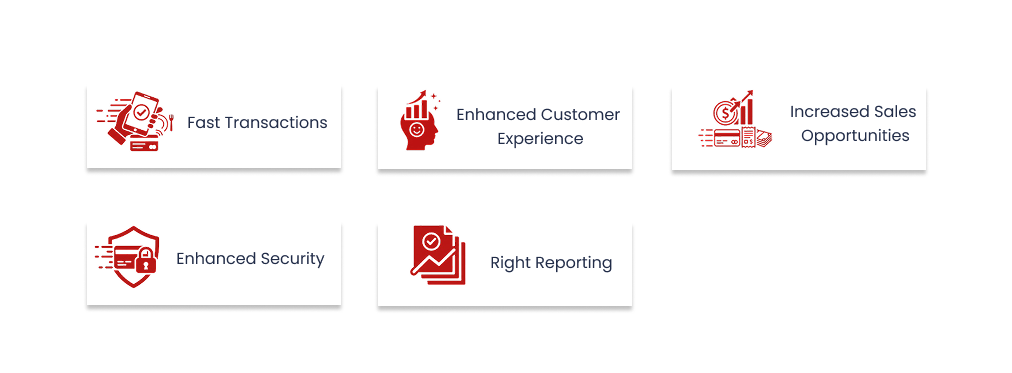
Fast Transactions
- The payment system helps restaurants to serve more guests by quick order processing and enhancing table turnover.
- Fast transactions help restaurants reduce long queues and waiting times.
- The quick transactions using cards, QR codes, and mobile wallets deliver seamless checkouts.
- It also reduces manual errors by integrating payment processing.
Enhanced Customer Experience
- Allows seamless transactions to encourage repeat customers and boost business profits.
- It provides a variety of payment options to make quick checkouts.
- With digital receipts, customers reduce the use of paper tickets.
- To provide more personalized service, it allows seamless mobile payments.
Increased Sales Opportunities
- It allows quick billing that helps restaurants serve more customers during peak hours.
- With tap-to-pay checkouts, it reduces long queues keep the service fast.
- By accepting card payments, contactless payments, and mobile wallets, it can target more and more customers.
- According to Mastercard, 79% of consumers worldwide now use contactless payments.
- The payment system allows customers to make quick purchasing decisions and encourages high order volume.
Enhanced Security
- This payment system with POS is fully PCI DSS compliant, meeting the security standards.
- It uses encryption to secure the cardholder information.
- As per the IBM research, the average data breach cost reached $4.45 million globally in 2023.
- Uses secure authentication procedures to avoid fraud and chargebacks.
- Following transparent processes helps build customer trust.
Right Reporting
- It automates the generation of sales reports, including daily, weekly, and monthly reports.
- This system offers real-time sales data, including transaction and payment types.
- It identifies the best-selling items, peak hours, and the least-selling items.
- The system helps optimize pricing and staffing through data-driven strategies.