12 Reasons to Become a White Label Software Reseller in 2026

Table of Content
- Becoming a White-Label Software Reseller in 2026
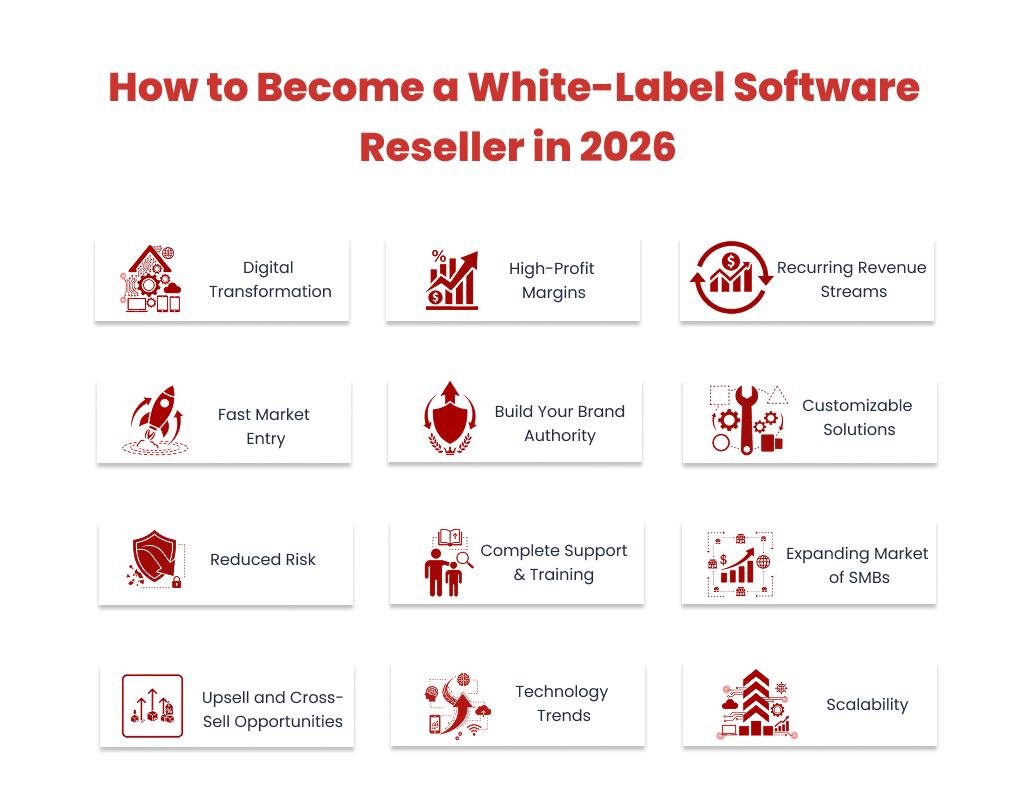
- 1. Digital Transformation
- 2. High-Profit Margins Without Development Costs
- 3. Recurring Revenue Streams
- 4. Fast Market Entry
- 5. Build Your Brand Authority
- 6. Customizable Solutions for Different Industries
- 7. Reduced Risk with Proven Products
- 8. Comprehensive Support and Training
- 9. Expanding Market of Small and Medium Businesses (SMBs)
- 10. Upsell and Cross-Sell Opportunities
- 11. Stay Ahead of Technology Trends
- 12. Scalability for Long-Term Growth
- Why the U.S. Market is Perfect for White Label POS in 2026
- Common Mistakes to Avoid as a White Label Reseller
- How to Get Started as a White Label POS Reseller
- Final Thoughts
- Frequently Asked Questions
Businesses nationwide are seeking innovative strategies to diversify their revenue streams and gain a competitive edge in the rapidly evolving digital economy of 2026.
The white label software reseller model is one of the most profitable opportunities.
White label POS systems have emerged as a particularly appealing option among the numerous white label solutions available, owing to the explosive demand for solutions that provide seamless payment and retail management.
Becoming a white label software reseller in 2026 can open doors to sustainable growth if you are an entrepreneur, software consultant, IT professional, or even a business owner looking to expand into the technology space.
Becoming a White-Label Software Reseller in 2026
Here are 12 compelling reasons to jump into this booming industry.
1. Digital Transformation
Digital transformation is currently taking place in businesses of all sizes across the United States, particularly in sectors such as retail, hospitality, and e-commerce.
Small businesses are seeking tools that are both affordable and powerful, capable of competing with those used by enterprise-level organizations.
As a white-label point-of-sale (POS) reseller, you can meet this demand by offering branded software with robust features that help merchants optimize operations, track sales, and enhance customer service.
The demand is unlikely to decrease anytime soon. In the modern business environment, point-of-sale (POS) systems are essential because an increasing number of businesses are adopting contactless payments, omnichannel sales, and real-time reporting.
2. High-Profit Margins Without Development Costs
A substantial amount of time, money, and technical knowledge is required to create proprietary software.
When you become a white label software reseller, you can bypass the overhead expenses associated with research, development, and testing.
Instead, you team up with a provider you can trust, give their product a makeover, and market it as if it were your own creation.
While maintaining high profit margins, this model enables you to concentrate your efforts on marketing, sales, and customer relationships.
The burden of in-house development is not something that many United States-based resellers have to worry about, as they have consistent recurring revenues.
3. Recurring Revenue Streams
In 2026, the software industry is largely dominated by subscription-based business models.
When you provide white label point-of-sale (POS) solutions, your customers typically pay either on a monthly or annual basis.
This generates recurring revenue, a significant advantage over business models that rely on one-time sales.
Recurring revenue is a smart investment for entrepreneurs in the United States, as it helps establish long-term financial stability, forecast growth, and increase business valuation.
4. Fast Market Entry
It may take you years to launch your own POS or SaaS product.
However, since you are a reseller of white label products, you can enter the market almost immediately.
The software has already been developed, tested, and certified to comply with the standards of the United States industry.
All you need to do is apply your branding, set up your pricing structure, and start onboarding customers.
In a competitive market, speed matters. The faster you launch, the quicker you can start generating revenue.
5. Build Your Brand Authority
White label solutions help you develop your brand for selling software.
A merchant sees your logo, communicates with your support, and links your technology to their business success each time they use your white label point-of-sale system.
In addition to creating opportunities for growth in related software verticals such as CRM, loyalty programs, and digital marketing solutions, this also enhances your brand authority in the U.S. market.
6. Customizable Solutions for Different Industries
White-label POS software is not a one-size-fits-all solution.
It can be tailored to meet the unique needs of industries like retail, restaurants, bars, salons, and convenience stores.
White-label software enables you to offer customized solutions to businesses in the United States.
For example:
- Online ordering and table management are two features that can be included restaurant’s point of sale system.
- Barcode scanning and inventory tracking are features that can be included in a retail point of sale system.
- Appointments and client loyalty can be managed by a salon POS.
7. Reduced Risk with Proven Products
When starting a new software business, one of the primary concerns is whether the product will be successful.
White label POS enables you to take advantage of an established platform that has been extensively used, tested, and optimized.
This reduces the possibility of expensive bugs, noncompliance, or subpar user experiences.
You retain the branding and financial advantages of ownership while still getting the dependability of a well-known product.
8. Comprehensive Support and Training
The majority of white label software suppliers, such as point-of-sale (POS) vendors, provide their resellers with comprehensive training and customer support.
This means you can succeed without being a POS specialist or software engineer.
The technical expertise is supplied by providers, allowing you to focus on building relationships and growing your client base in the United States.
This makes the business model accessible for entrepreneurs from various backgrounds.
9. Expanding Market of Small and Medium Businesses (SMBs)
SMBs comprise 99.9% of all businesses, according to recent U.S. statistics.
The majority of them use point-of-sale (POS) systems but are unwilling to pay for enterprise-level solutions.
As a white label POS reseller, you have a fantastic opportunity to provide scalable, reasonably priced technology that precisely matches the needs of the small business sector in the USA.
As these SMBs grow, they’ll continue to rely on your branded solutions, ensuring long-term customer relationships.
10. Upsell and Cross-Sell Opportunities
A white label point-of-sale system is only the first step.
You can upsell extra services like these once you’ve gained your clients’ trust:
- Loyalty and rewards programs
- Customer relationship management (CRM) tools
- Online ordering platforms
- Payment processing solutions
The POS serves as the main product, and upsells maximize each customer’s lifetime value by generating multiple revenue streams.
11. Stay Ahead of Technology Trends
By 2026, point-of-sale (POS) systems will have evolved beyond simple cash registers.
They incorporate cloud-based reporting, omnichannel sales, mobile payments, and analytics.
You can obtain these innovations by working with a white label provider without having to make your own R&D investments.
Your clients in the United States will view you as a progressive supplier who consistently keeps them competitive with cutting-edge technology.
12. Scalability for Long-Term Growth
Scalability is one of the benefits of selling white label software.
Without making significant infrastructure changes, you can begin small, focusing on local companies in your city, and then grow throughout the United States.
Recurring revenue increases along with your clientele, enabling you to make additional investments in partnerships, marketing, and new verticals.
Software reselling can grow quickly, offering exponential growth opportunities in contrast to traditional businesses with physical constraints.
Why the U.S. Market is Perfect for White Label POS in 2026
The U.S. remains one of the most dynamic markets for POS innovation, presenting a prime opportunity for white-label resellers in 2026.
Several factors contribute to this distinctive environment:
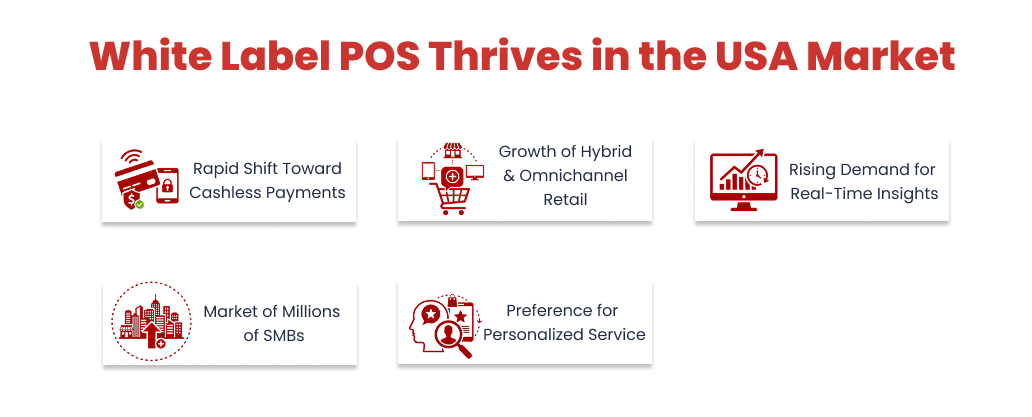
Rapid Shift Toward Cashless Payments
Consumers now expect contactless cards, digital wallets, and mobile payments.
Businesses are actively seeking point-of-sale (POS) systems that seamlessly integrate with multiple payment methods, as credit and debit card usage continues to dominate the transaction landscape.
Growth of Hybrid & Omnichannel Retail
American companies are rapidly adopting hybrid retail models, which incorporate features such as curbside pickup, online ordering, and in-store returns.
This calls for POS platforms that are adaptable and scalable, an area in which white label solutions excel.
Rising Demand for Real-Time Insights
Data-driven decision-making tools are becoming popular among small and medium-sized enterprises.
Sales analytics, customer insights, and real-time inventory management are no longer “nice-to-have” features; they are now necessary.
Resellers are in a strong position when a white label point-of-sale system is offered with extensive reporting features.
A Market of Millions of SMBs
More than 33 million small businesses operate in the United States, and many of them continue to use outdated or costly point-of-sale systems.
This gives resellers a great opportunity to offer reasonably priced, modern alternatives.
Preference for Personalized Service
Small business owners in the United States frequently prefer localized, individualized support over big, one-size-fits-all providers.
You can build lasting, loyal relationships that are difficult for major players to match by branding and customizing a white label point of sale system for industries such as retail, food service, health, or beauty.
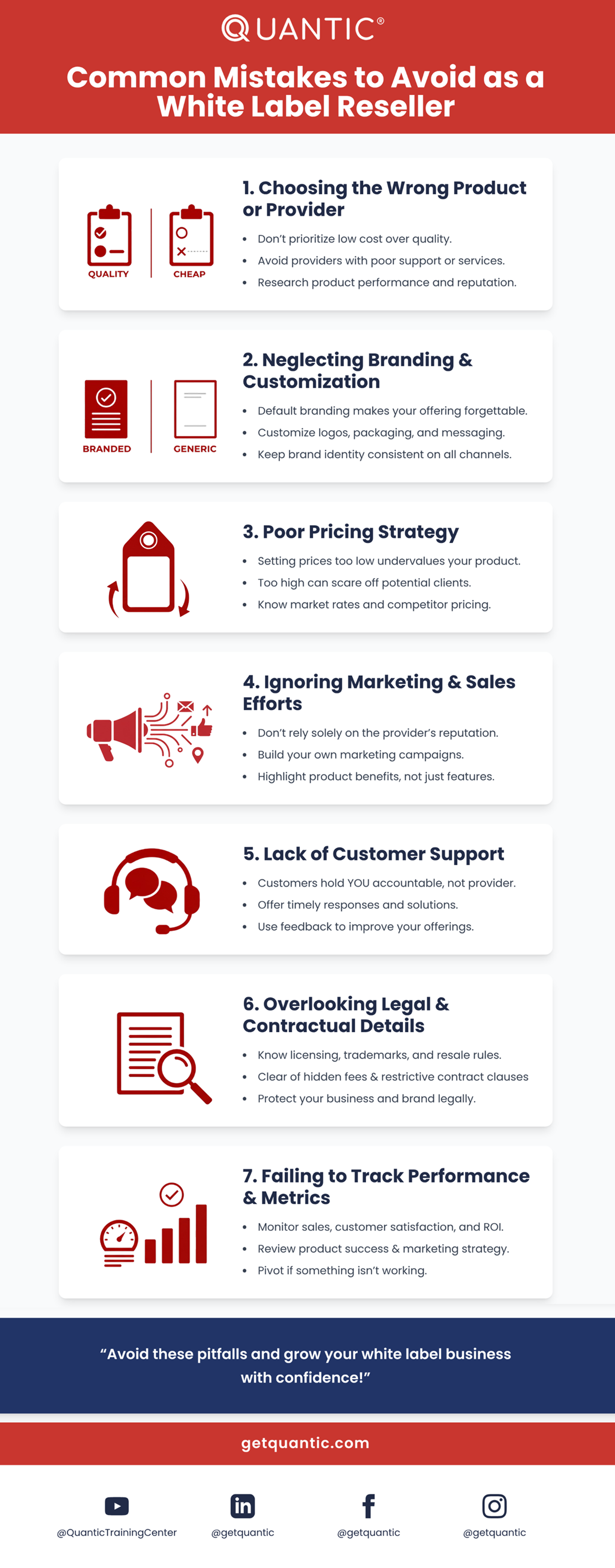
Common Mistakes to Avoid as a White Label Reseller
How to Get Started as a White Label POS Reseller
By leveraging a white-label solution instead of building software from scratch, becoming a point-of-sale reseller is a smart way to enter the rapidly growing payment and business management sectors.
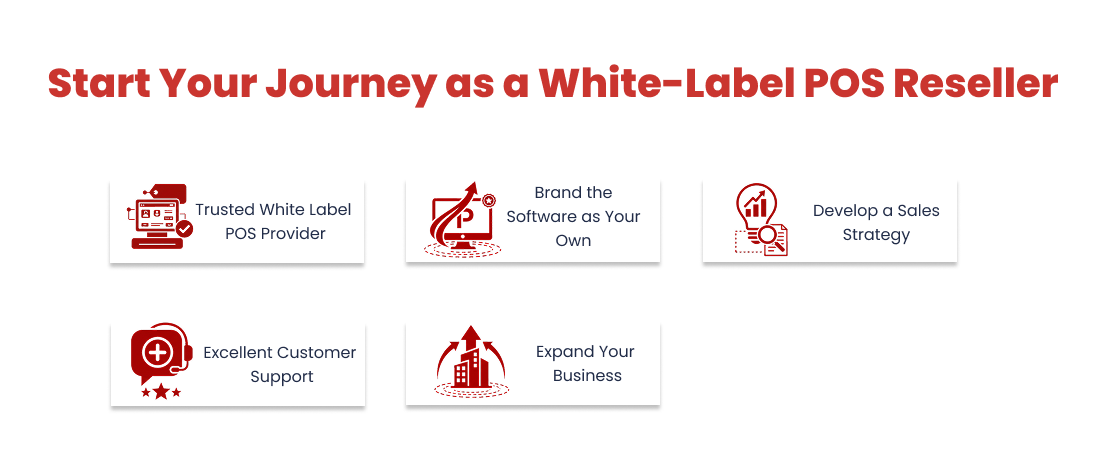
If you’re ready to get this opportunity, here’s a step-by-step guide to get started:
Choose a Trusted White Label POS Provider
Your success is significantly impacted by the partner you choose.
Select a platform, like Quantic POS, that has a proven track record of success, cutting-edge features, and customization options.
Look for necessary features, such as inventory control, reporting, support for multiple locations, and integrations with reputable payment processors.
Brand the Software as Your Own
One of the key advantages of white labeling is the ability to customize the solution.
Make it seem like a proprietary product to customers by using your domain, brand colors, and logo.
You will also create your own pricing models, such as subscription-based, transaction-fee, or packaged packages, to maximize profitability.
Develop a Sales & Go-to-Market Strategy
Create a value proposition that specifically addresses the needs of your target market, which may include restaurants, shops, salons, or other SMBs. Think about utilizing:
Digital marketing campaigns (social media, SEO, paid ads)
Referral programs (partnering with payment processors, IT consultants, or local agencies)
Direct outreach (trade shows, networking events, cold outreach to local businesses)
Offer Excellent Customer Support
Customer trust is essential for long-term growth.
To ensure your clients are successful with your point-of-sale system, offer training sessions, onboarding materials, troubleshooting support, and frequent updates.
You can increase customer retention and referrals by building a reputation for providing dependable support.
Scale and Expand Your Business
Start small, focus on nearby SMBs, and improve your procedure.
Reach out to other areas or verticals after you have a strong clientele.
To diversify revenue, consider creating a network of resellers or additional services, such as merchant services, hardware leasing, or advanced analytics.
Final Thoughts
One of the best business decisions you can make in the United States in 2026 is to become a reseller of white label software.
Businesses are actively looking for reliable suppliers who can meet the growing demand for advanced, adaptable, and reasonably priced point-of-sale (POS) systems.
White-label point-of-sale (POS) solutions allow you to enjoy recurring revenue, brand growth, and scalability without the risks and costs associated with developing software from scratch.
Quantic POS can be your reliable success partner if you’re ready to take advantage of the chance.
As a white-label POS reseller, you can expand your business and establish your brand with confidence when you have access to U.S.-focused solutions, tested technology, and extensive support.