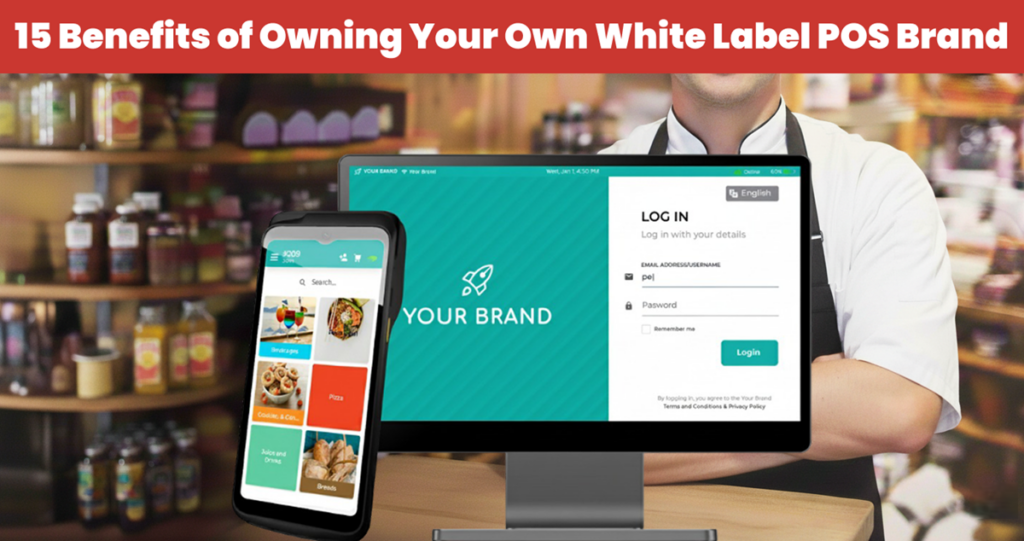
Choosing the Right White Label POS Software in 2026: Everything You Need to Know

Table of Content
- What Is White Label POS Software?
- Why Go With a White Label POS Solution?
- Key Criteria for Choosing the Right White Label POS Software in 2026
- 1. Regulatory & Security Compliance
- 2. Customization & Branding
- 3. Vertical-Specific Features
- 4. Hardware Compatibility
- 5. Integrations
- 6. Scalability & Reliability
- 7. Vendor Support & Partner Program
- 8. Pricing Model & Margins
- 9. User Experience & Usability
- 10. Compliance with U.S. Tax & Payment Regulations
- Top 10 Emerging Trends Shaping White-Label POS Systems
- Common Pitfalls & Challenges to Avoid
- What to Expect from a Right White Label POS Partner – Quantic POS?
- Conclusion
- Frequently Asked Questions
- What is white label POS software?
- Who should use white label POS software?
- Why choose white label POS software instead of building my own?
- Can I customize the features and branding of a white label POS system?
- Is white label POS software compliant with U.S. payment and tax regulations?
- How much does white label POS software cost?
- What hardware does white label POS software support?
- Can white label POS software handle both online and in-store sales?
- What kind of support should I expect from a white label POS provider?
Point-of-sale (POS) systems are more than just a transactional tool in a marketplace where successful businesses are defined by their brand identity, customer experience, and operational efficiency.
They are located where workflow, customer data, branding, and revenue all connect.
White label POS software is becoming a more appealing choice for many US-based companies, particularly resellers, ISOs, SaaS providers, and merchant service providers.
White label solutions save time, money, and risk by enabling you to rebrand, modify, and resell or deploy an established POS platform under your own name rather than creating POS software from the ground up.
However, not every white-label point-of-sale system is created equal.
Understanding your business objectives, the features you need, technical and legal concerns, and the vendor relationship are all important when selecting a system.
U.S. business owners can use this guide to assess what to look for, what to avoid, and how Quantic POS positions itself as a white label POS partner.
What Is White Label POS Software?
A white label POS software is a fully functional point-of-sale system built by one provider, which another business can adopt, brand, customize, and deploy as its own.
You have complete control over its appearance (branding, user interface, logos), features (custom modules, integrations), and pricing or packaging for your customers or retail locations.
While you focus on your value proposition, branding, sales, support, and possibly vertical specialization, you can license or work with a vendor who takes care of the core infrastructure, payment processing, and hardware integrations.
In the U.S., white label POS systems are popular among:
- Resellers who want to offer POS systems under their own brand.
- SaaS and tech companies aiming to expand into retail or hospitality.
- Payment processors and ISOs offering bundled services.
- Chains, franchises, and multi-location businesses want uniform POS systems that match their brand
Why Go With a White Label POS Solution?
Choosing the best POS system involves more than just handling payments in the competitive business environment, particularly in the US market.
It concerns scalability, customer experience, efficiency, and compliance.
White-label POS solutions excel in this scenario. You can leverage an established, tested platform and adapt it to fit your brand, instead of spending years building a system from scratch.
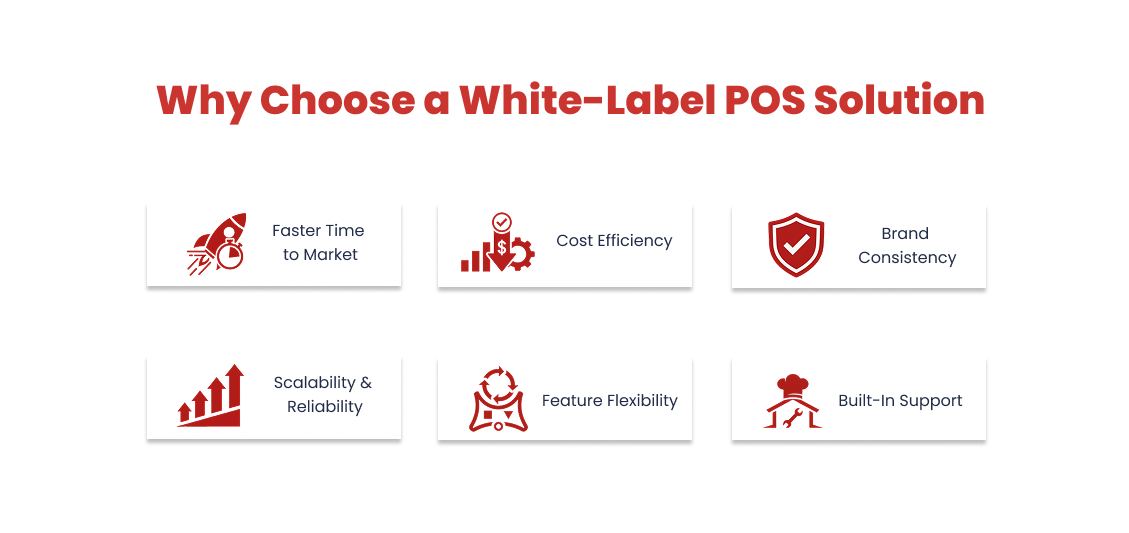
This is why it makes sense:
1. Faster Time to Market
Building a point-of-sale system from scratch takes years of development, testing, bug fixes, and ensuring regulatory compliance.
White-label POS providers eliminate these delays.
You can go live in a fraction of the time, as most are already pre-certified for U.S. regulatory and security requirements.
2. Cost Efficiency
It is costly to build and maintain your own point-of-sale system.
Expenses can quickly mount up due to R&D, processor integrations, hardware compatibility, and continuing compliance requirements.
White-label POS solutions let you deliver a strong product without making significant upfront investments.
3. Brand Consistency & Customer Trust
Your POS system serves as your primary means of communication with your clients.
With white label POS solutions, you can completely customize backend dashboards, apps, interfaces, and receipts with your company’s branding.
Every interaction keeps your brand highly visible while reinforcing professionalism and building customer trust.
4. Scalability & Reliability Through Well-Developed Systems
White-label point-of-sale systems are tried and tested in high-pressure retail, dining, and service industries.
They offer advanced features like multi-location support, sales analytics, inventory tracking, and reporting.
Thanks to their dependability, you can scale your business without worrying about functional gaps or system failures.
5. Feature Flexibility & Industry-Specific Solutions
Not every business requires the same point-of-sale system.
A fine dining establishment or retail chain will function differently from a food truck.
White-label point-of-sale (POS) providers often offer modular features, letting you select exactly what you need, such as barcode scanners, loyalty programs, kitchen display systems, and more.
6. Built-In Support & Compliance
PCI DSS compliance, data security, fraud prevention, backups, and frequent updates are just a few of the many obstacles that come with processing payments.
A white-label provider handles these complex tasks for you, so you don’t have to manage them internally.
Additionally, committed support ensures seamless operations in the event of problems.
Key Criteria for Choosing the Right White Label POS Software in 2026
Finding a platform that can satisfy the demands of the US market, legal requirements, and industry-specific requirements is more important when choosing a white label point-of-sale system than considering features or price alone.
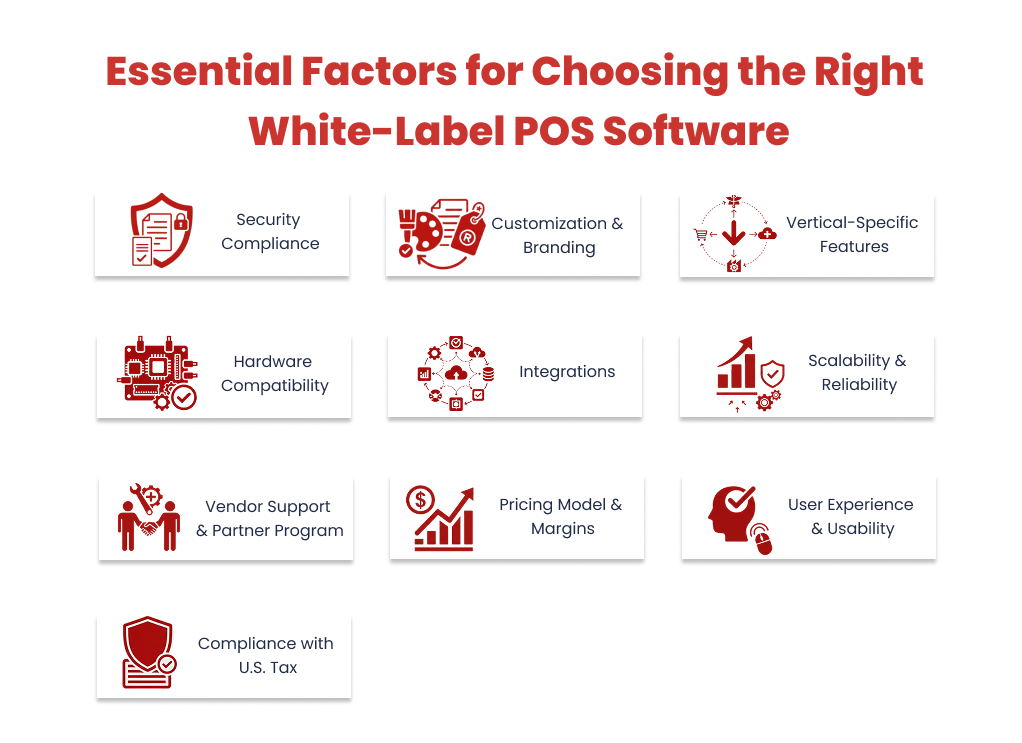
The following are the main factors to consider, along with how Quantic POS handles them:
1. Regulatory & Security Compliance
Tokenization, secure cloud infrastructure, PCI-DSS certification, and compliance with privacy regulations.
Why it matters:
U.S. businesses face strict regulations on payment data and privacy.
Non-compliance risks fines, lawsuits, and reputational damage.
Quantic POS Advantage:
With its advanced end-to-end encryption and PCI-DSS compliance, Quantic ensures resellers’ peace of mind, ensuring their merchants are fully protected from data breaches and legal risks.
2. Customization & Branding
You should be able to modify features, create apps that are viewed by customers and merchants, and manage branding components like the logo, colors, and user interface.
Additionally, you should be flexible with your margins and pricing.
Why it matters:
While customization enables you to stand out in a crowded market, consistent branding strengthens trust.
Quantic POS Advantage:
With Quantic’s white-label program, you can completely rebrand the platform, including the interfaces, apps, and receipts, to put your company’s identity front and center at all times.
3. Vertical-Specific Features
Retail establishments require barcode scanners, inventory tracking, and product return management, while restaurants require kitchen display systems and table management.
Workflows for food trucks and service providers are completely different.
Why it matters:
Every industry has different operational requirements, so your point-of-sale system should work with your merchants as they do.
Quantic POS Advantage:
The POS feels customized for every kind of business thanks to Quantic’s vertically focused modules, which include retail inventory tools, delivery integrations, and restaurant KDS.
4. Hardware Compatibility
Ensure the POS is compatible with iOS and Android and supports a variety of devices, including terminals, tablets, printers, and scanners.
In areas with unreliable connectivity, features like offline mode are essential.
Why it matters:
From mobile vendors to bustling city eateries, American businesses operate in a variety of environments.
Hardware adaptability ensures smooth operations.
Quantic POS Advantage:
To keep businesses running even when there is no internet, Quantic integrates with numerous payment terminals, supports offline transactions, and operates fluidly on iOS and Android tablets.
5. Integrations
Look for integrations with delivery apps, accounting systems, CRM tools, e-commerce platforms, loyalty programs, payment gateways, and payroll systems.
Why it matters:
Your POS becomes a part of a more comprehensive and efficient ecosystem through seamless integrations, which also prevent silos and minimize manual labor.
Quantic POS Advantage:
By integrating with leading processors, delivery networks, loyalty programs, and accounting software, Quantic provides merchants with a complete system right out of the box.
6. Scalability & Reliability
Examine if the platform provides disaster recovery, uptime guarantees, multi-location support, cloud or on-premise options, and high-volume transaction processing.
Why it matters:
Your POS must grow with the business without experiencing any hiccups or outages.
Quantic POS Advantage:
With its multi-location support, cloud-first design, and track record of dependability, Quantic is a scalable solution for small businesses and large corporations.
7. Vendor Support & Partner Program
Seek out merchant training, onboarding materials, committed account managers, 24/7 assistance, transparent SLAs, and openness in product roadmaps.
Why it matters:
Robust vendor support ensures seamless rollouts and prompt problem-solving.
Quantic POS Advantage:
Quantic provides training materials, onboarding support, and dedicated reseller assistance to ensure you and your merchants have guidance at every stage.
8. Pricing Model & Margins
Examine licensing fees, revenue-sharing plans, transaction costs, upgrade fees, and continuing maintenance expenditures.
Why it matters:
In addition to revenue, the POS partnership’s cost and margin structures also affect profitability.
Quantic POS Advantage:
Quantic helps resellers increase margins while maintaining predictable costs for merchants through flexible revenue-sharing plans and clear pricing.
9. User Experience & Usability
Fast checkout processes, user-friendly dashboards for reporting, and straightforward inventory management are all necessary for merchants and employees.
Why it matters:
An easy-to-use system boosts adoption rates, decreases training expenses, and minimizes errors.
Quantic POS Advantage:
With its user-friendly tools and intuitive dashboards, Quantic was created with simplicity in mind, reducing training time and increasing merchant adoption.
10. Compliance with U.S. Tax & Payment Regulations
The system must manage industry-specific regulations (such as those about alcohol, tobacco, and CBD), complex sales tax laws across states, local compliance issues, payment processing fees, and refunds.
Why it matters:
Compliance is essential to avoid costly mistakes arising from inconsistent tax laws and industry-specific regulations.
Quantic POS Advantage:
The burden on merchants is reduced by Quantic POS, which automatically computes state and local sales tax and supports industry-specific compliance workflows.
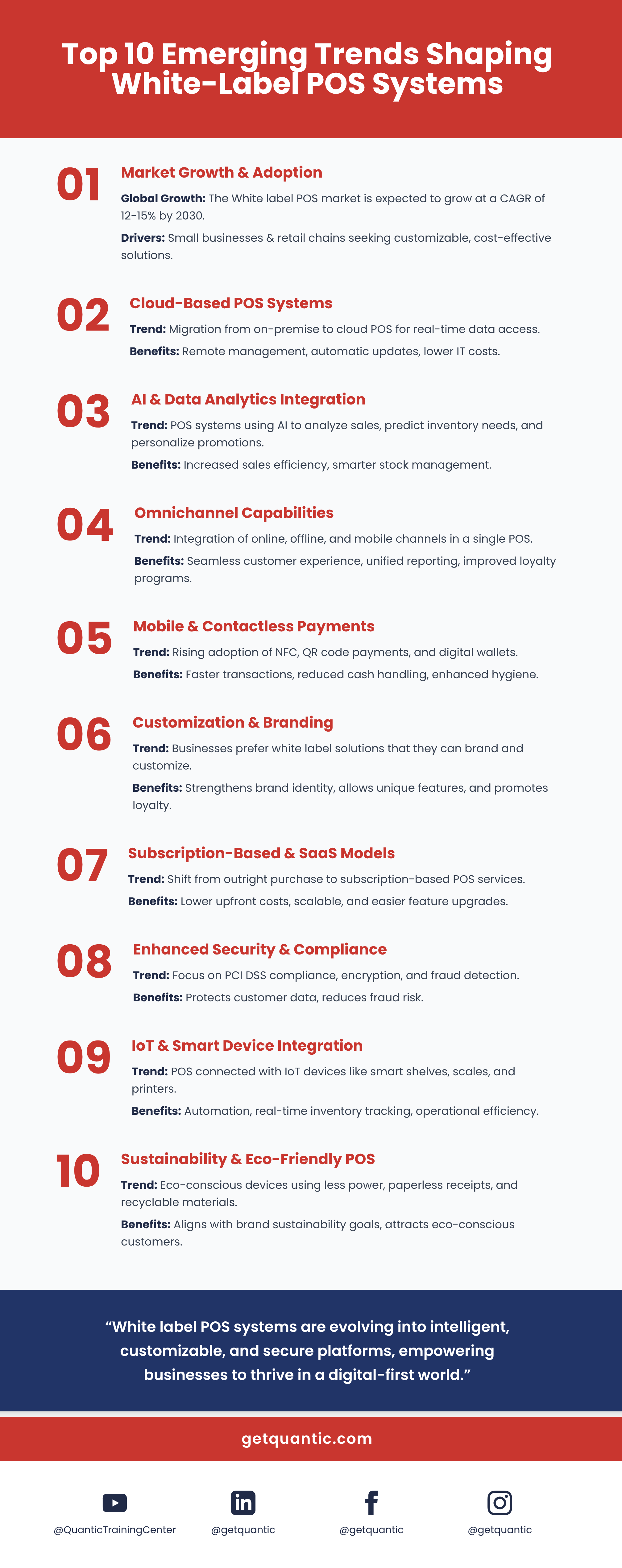
Top 10 Emerging Trends Shaping White-Label POS Systems
Common Pitfalls & Challenges to Avoid
Even with numerous white-label point-of-sale options, business owners often encounter preventable issues.
You can make better decisions when you are aware of the situation.
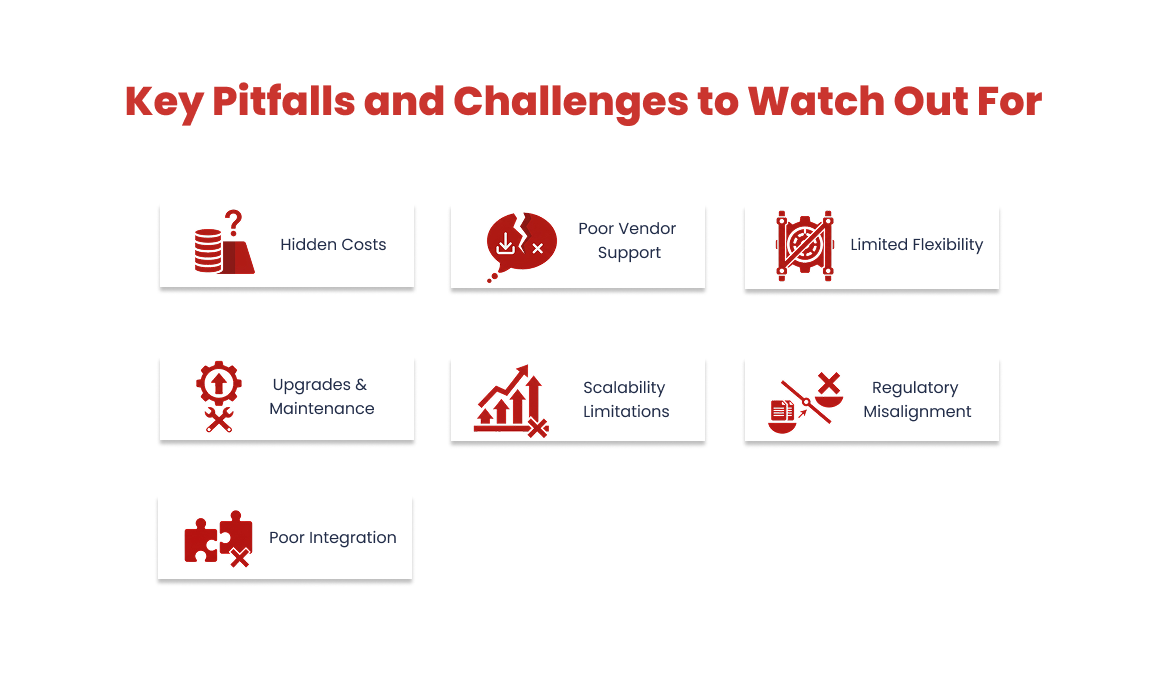
Hidden Costs
Beyond the base license, additional costs may apply for hardware compatibility, onboarding and training fees, version upgrades, and custom feature requests.
With its clear pricing and adaptable reseller models, Quantic helps partners avoid unpleasant surprises while still gaining access to new features and upgrades.
Slow or Poor Vendor Support
Slow rollouts or poor documentation from your vendor may affect merchant satisfaction.
Quantic ensures that resellers and merchants receive prompt assistance by offering committed account managers, 24/7 technical support, and comprehensive onboarding materials.
Limited Flexibility
Deep customization is not possible with every solution; if you’re limited, you could risk your operations or branding.
Quantic’s comprehensive white-label program allows you to customize workflows, pricing, branding, and apps to align with your point-of-sale system and your market strategy.
Upgrades & Maintenance
Your end users may suffer if upcoming updates are slow or break backward compatibility.
Additionally, be aware of whether you will have to upgrade when you would prefer to remain stable.
While constantly adding new features to the platform, Quantic ensures that updates are seamless and backward-compatible, protecting merchant workflows.
Scalability Limitations
When scaled to multiple outlets or when the number of concurrent users or transactions increases, a system that functions well for one store may not perform as well.
Quantic is built for scalability, capable of handling high transaction volumes, multi-location operations, and enterprise-level growth without performance issues.
Regulatory Misalignment
Laws related to payments, taxes, or business verticals can be complicated, especially in the United States. Here, taking shortcuts can be dangerous.
To help businesses stay compliant with local regulations, Quantic manages U.S. sales tax, regulatory workflows, and sector-specific compliance requirements, such as those for alcohol and central business districts.
Poor Integration
Your operational efficiency decreases if your point-of-sale system is not well integrated with other systems, such as accounting, e-commerce, and CRM.
Businesses can operate on a connected ecosystem thanks to Quantic’s seamless integrations with top payment processors, accounting platforms, loyalty programs, and delivery services.
What to Expect from a Right White Label POS Partner – Quantic POS?
U.S. business owners require more than just software when choosing a white-label POS partner.
They are a platform that enables them to establish their own brand, adjust to the verticals they have selected, stay compliant, and grow profitably without losing control.
Our White Label Program at Quantic POS is made to meet these standards.
Here’s how we distinguish ourselves as the preferred partner for progressive companies.
1. Complete White Label Branding & Customization
Your point-of-sale system should never promote another brand.
Every interaction you have with Quantic reflects your own brand identity:
- Super App: Completely rebranded with your name, theme, and logo.
- Office Backend & Merchant Dashboards: Instead of using a generic platform, merchants access your branded portal.
- Customer-Facing Tools: Digital receipts, loyalty programs, kiosks, and online ordering all highlight your brand.
2. Feature Flexibility & Vertical Adaptability
Different workflows are for different verticals; for example, a full-service restaurant operates differently from a grocery store or vape shop.
The purpose of Quantic POS is to flex:
- Supports the retail and hospitality verticals, including mini-markets, specialty shops, groceries, liquor, restaurants (FSR/QSR), cafés, and CBD/vape.
- Partners can specify which features are displayed for each vertical.
- Custom modules meet the demands of your market and allow you to request new features or tailored workflows.
3. Strong U.S.-Relevant Compliance & Hardware Integration
Businesses in the United States have specific hardware and compliance needs.
Quantic POS confronts them head-on:
- Payment processor integrations: flexibility to work with various U.S. acquirers and processors.
- Certified hardware support: compatibility with printers, EMV terminals, cash drawers, kiosks, and tablets widely used in the market.
- Data security: PCI DSS alignment, secure encryption, routine backups, and offline + cloud-based resilience.
4. Training, Onboarding & Dedicated Support
When people feel supported, they are more likely to adopt technology.
For this reason, Quantic pairs partners with actual resources:
- Training materials and onboarding playbooks for reseller employees and merchants.
- Dedicated account managers to oversee deployments and promptly address issues.
- Continuous assistance and a knowledge base to ensure you never feel alone.
5. Control Over Your Pricing & Margins
You have complete control over your business model in a true white-label partnership.
Using Quantic:
- You decide merchant pricing and service tiers.
- There are no forced revenue splits or hidden markups; you set your own margins.
- You are free to select from bundled offerings, percentage-based fees, or flat fees.
6. Fast Deployment & Continuous Updates
It can take years to build a point-of-sale system from scratch.
You can quickly enter the market with Quantic:
- A feature set that has been pre-built and matured ensures instant deployment readiness.
- Quick deployment launch with merchants in a matter of weeks rather than months.
- Our team manages ongoing updates and enhancements, from new security procedures to app store submissions.
Conclusion
Choosing the best white-label point-of-sale software is a smart decision that can significantly impact your company’s productivity, customer satisfaction, brand identity, and profitability in the U.S. market.
The ideal solution meets the demands of your industry, gives you the flexibility and branding choices you need, ensures security and compliance, offers robust partner support, and enables you to grow.
Deep customization, robust support and onboarding, margin control, versatility across business types, and advanced product features are just a few of the key elements that Quantic POS provides.
We would be pleased to help you determine whether Quantic is the right choice for implementing a white-label point-of-sale system.
Contact our partner team or request a demo.